World Primer
The timeline of Selerim is that of a world wounded by war and calamity. The few and disparate Living Realms are divided by vast tracts of arcane fallout, a devastating reminder of the brutal war fought at the world’s inception. Within each of these isolated pockets of life, civilization advances at a varying, non-linear pace.
In these times, we fix our focus on the Inhabitable Lands–largest of the Living Realms and host to many fantastic environs, ancient and new:
- Nova Jersaeria, metro-capital of the expansionist Kingdom of Tiialia, stands as a beacon of civilization and progress–despite constant conflict between its noble families.
- The inheritors of Selerim’s ruthless aboriginals–the Vlorn Dynasty–plot their long-awaited vengeance against the surface dwellers in the hidden subterranean city of Vlorngroth.
- Thieves and merchants alike ply their trade in the free port city of Scrimshaw, all while a corporatized abyssal rift rages beneath the city’s mean streets.
- The Darkwells and other Planar Rifts lie dormant in the hidden places of the realm, waiting to be rediscovered and harnessed.
- The quiet lifestyle of settlements on the Tanglewood Peninsula has been disrupted by mutated monsters, and the call for adventurers has never been louder.
- Progressive arcane theory and unheard-of adventures await new students at White Grove, Tiialia’s most reputable (and only) state-sanctioned magical academy.
- The Salted City of Corrodreth, born of a forgotten empire and destroyed within living memory, offers hints at a civilization beyond the deadly Violet Bleed to the far west.
Namesake
Selerim was first settled over 8,000 years ago by Selvetarm, the dark elf (drow) god of war. For two centuries, Selvetarm and his drow followers used the world as a brutal factory of war, exhausting its resources and creating Planar Rifts to steal and enslave folk from other worlds. Despite his terrible deeds and his eternal banishment into the Infinite Abyss, Selvetarm remains the world’s namesake to this day.
The Inhabitable Lands, named by The Seldarine before they departed Selerim, were named as such because they were thought to be the planet’s only habitable lands after the destruction wrought by the Nameless War and the onset of the Violet Bleed.
Peoples
The diversity seen amongst the peoples of the Inhabitable Lands is such because their ancestors were slaves, stolen from their various home worlds to work and die for the glory of The Dark Seldarine empire. In the towns, villages, and cities of Selerim, you will see all manner of humanoid species interacting, cooperating, and coexisting. The world is not without bias and strife, but there exists an uncommon sense of togetherness when your ancestors were all collectively enslaved. The clear exception to this unity is, of course, the drow who remain on Selerim. The drow of Vlorngroth are openly hostile to surface dwellers, while the drow living on the surface skirt around the edges of civilization, fearing reprisal for their people’s part in the histories.
Technology
In the last century of relative peace, invention and ingenuity centered around Nova Jersaeria and Scrimshaw City have pushed the Inhabitable Lands into early industrial technologies. Calamity, strife, and conservatism have dampened technological advancement for other regions of the Inhabitable Lands. Mitlin and population centers on the Tanglewood are slower to adopt new technologies when magic is more prevalent and more useful. The blending of magic and technology, coined “Magitech” by Arctur Execlostrabaum is also being studied and advanced at White Grove. Independently, and more recklessly, the Cronium Gnomes of Crabbley have developed an inter-planar teleporter that perfectly blends sorcery with new technology.
Distance, isolationism, and the Violet Bleed have largely prevented the spread of new technology to far-flung places like Mournholde and Fordsfaire—both make do with medieval technologies. As for the other Living Realms of Selerim, there is no telling what technologies are in use. However, it is unlikely that any one realm has achieved a level of technological advancement greater than that of the Inhabitable Lands.
Magics
As a high fantasy setting, magic is widely available on Selerim. Most folk can learn to harness magic with the correct training. In the Inhabitable Lands, the innate magic of sorcery was anomalously rare until the blood of dragons slain in the Generations’ War seeped into the ground, near the present day Forsaken Expanse. To this day, most sorcerers of Selerim are born on the eastern side of Tanglewood Peninsula where the concentration of dragon blood is strongest.
Geography
With the exception of the Inhabitable Lands, where most of our adventures take place, the Living Realms of Selerim are largely undocumented. Within the Inhabitable Lands, there are tales of other Living Realms, but travel between them is prohibitively difficult, even in this age. The Inhabitable Lands themselves, now so diminished by Darkwell floodwater, span a 400 mile strip along Selerim’s equator.
Astronomy
The world of Selerim is analogous to the Earth, with similar gravity and rotational patterns… unless I come up with something cooler at some point. Lunadel is Selerim’s only surviving moon, and Seladel is the solitary star around which Selerim orbits. As of 264 B.T., the most widely used calendar is the Selerim Unified Calendar, which very conveniently has 13 months of 28 days each.
Cosmology
Selerim is assumed to follow the Great Wheel cosmology configuration as described in the D&D Dungeon Master’s Guide, with few exceptions:
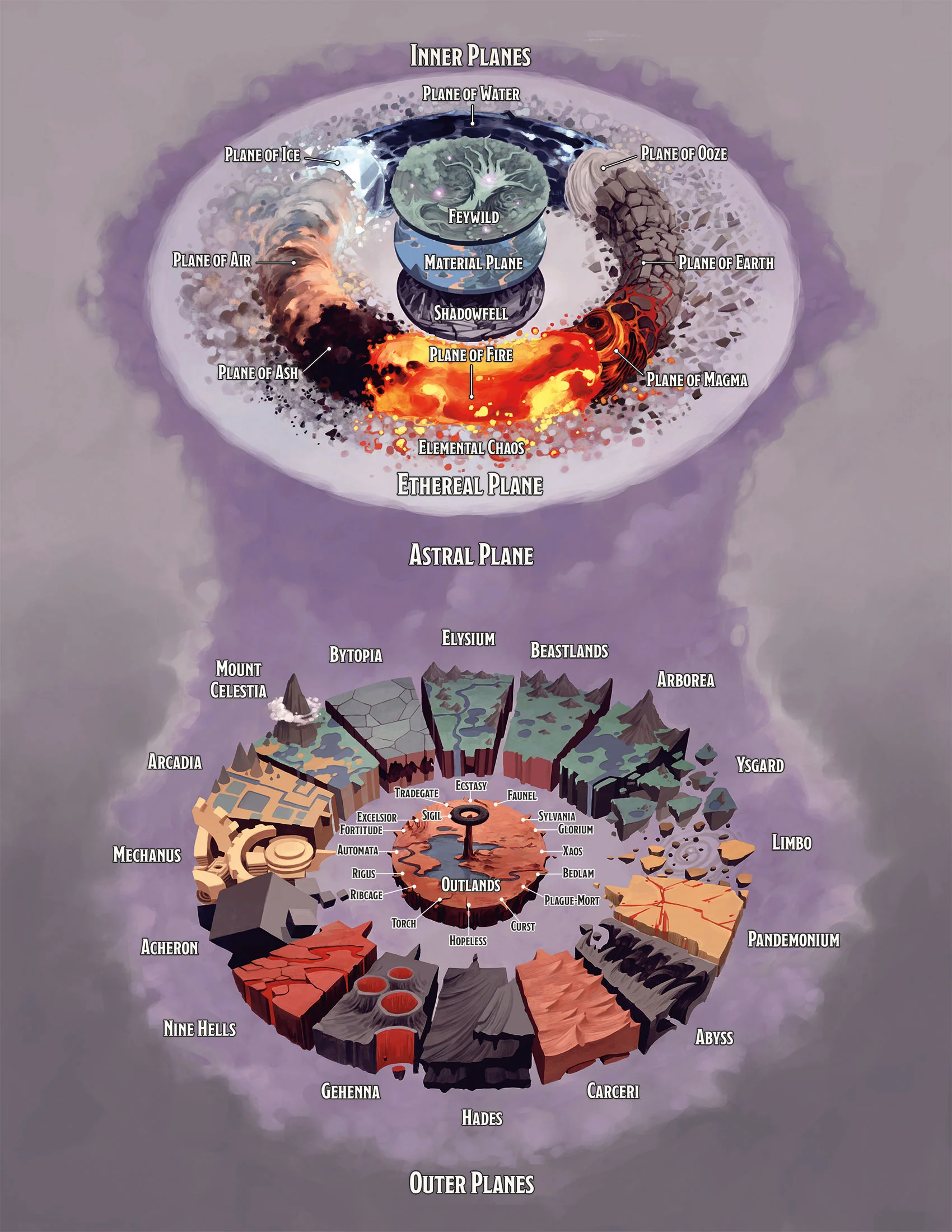
- Due to its damaged ley lines, extraplanar travel is typically easier on Selerim than it is in other worlds.
- As they are reflections of the Material Plane, the Feywild and the Shadowfell are similarly affected by the Violet Bleed.